 Store
LEARN THE FRETBOARDONE STRING AT A TIME
You know a few chords, maybe a riff or two, but ask you where the C is on the A string and it's a guess.
That's normal: most guitarists learn shapes first and notes much later, if ever. The good news is that the neck follows one simple rule, and with short daily practice the notes stick. Below is a four-step method. Each step comes with a game you can play right now in Fretblast, on your real guitar or by tapping.
Why learn the notes at all?
- Chords anywhere. A barre chord is named by the note under your first finger. Know the notes on the low E and A strings and you can play any major or minor chord up the neck.
- Solos that make sense. Knowing which note you're on is the difference between noodling and choosing.
- Talking with other players. "It's in G, start on the 3rd fret" only helps if you know what that means.
- Moving riffs around. Play a riff higher, lower or in another key without relearning it.
STEP 1Learn the one rule the neck follows
Notes go A B C D E F G, then back to A. Each fret is a half step. Most natural notes are two frets apart, with one exception: B to C and E to F are only one fret apart. The fret in a two-fret gap is a sharp or flat (between A and B is A♯, also called B♭).
And at the 12th fret, everything starts over: the 12th fret is the open string's note again, an octave higher.
That's it. With that rule you can count to any note from any open string. On the low E: E (open), F (1), G (3), A (5), B (7), C (8), D (10), E (12).

"How the neck works" walks up a string note by note and shows every gap. Then race it in Laser Speed: your bike rides along the string, and you play each next note to keep it moving.
Play Fretblast →STEP 2One string at a time, natural notes first
Don't try to learn the whole neck at once. Start with the low E string, open to the 5th fret, then go up to the 12th, then move to the A string. Those two strings name most of the chords you'll ever play, so they pay off first.
Leave the sharps and flats for later. Once you know the natural notes, every sharp or flat is simply the fret in between.
Say each note out loud as you play it. Your ears, eyes and hands all learn it at once.

The mastery map starts on the low E string, frets 0 to 5. Notes fall toward the neck and you blast each one by playing it. Each level adds frets or a string, and three stars on a level means you've got it.
Play Fretblast →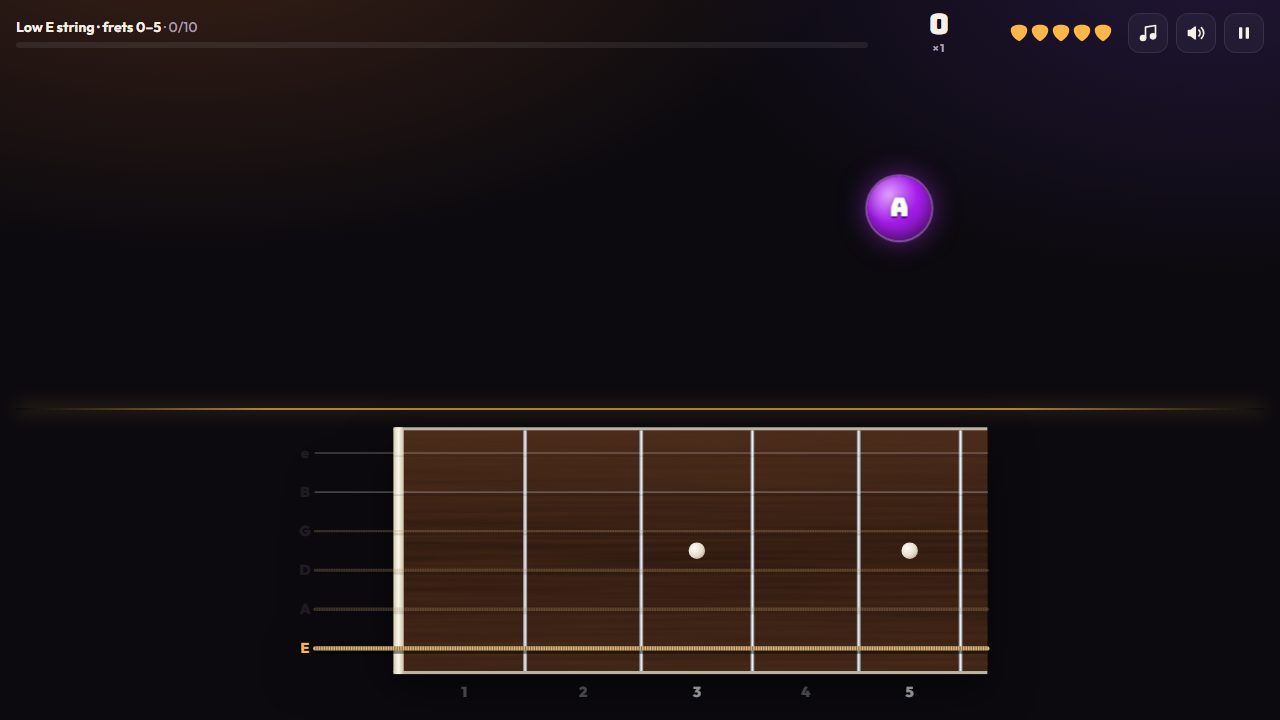
STEP 3Find the same note on other strings
You don't have to memorize every spot separately. Three shortcuts connect them:
- The 5th fret is the next open string. The 5th fret of the low E is A, the open A string. This works on every string except one: from the G string to the B string, it's the 4th fret.
- The octave shape: skip a string, up two frets. E on the low E string's open, E again on the D string's 2nd fret. Going across to the B or high e string, it's up three frets instead.
- Landmarks. Know a few spots cold, like the open strings and the 5th, 7th and 12th frets, and count from the nearest one instead of from the nut.
These shortcuts also tell you where to play a note without moving your hand, which is what you'll want once you're playing riffs and solos.

"Neck shortcuts" shows each trick on the neck. Then Octave Hunt asks you to find the same note in every place it lives.
Play Fretblast →STEP 4A few minutes a day, on your weak spots
Memory sticks with short, regular practice, not one long session. Five minutes every day beats an hour on Sunday. And spend most of that time on the notes you're slowest at, not the ones you already know.

The Daily gives everyone the same 20 notes each day. Keep your streak going and compare scores. Fretblast keeps track of the notes you take longest to find, and its weak spots drill brings those back until they're quick.
Play Fretblast →A 5-minute daily plan
- Tune up. The tuner is built in.30 seconds
- The Daily.about 2 minutes
- Your current level on the mastery map, or one new string.2 minutes
- Weak spots to finish.30 seconds
Why a game works better than a chart
A fretboard chart shows you the answer. A game makes you find it, over and over, against a little time pressure, and tells you instantly whether you were right. That's how memory works best: recalling, not rereading.
Playing on your real guitar matters too. Your fretting hand learns where the note is, not just your eyes, and that's what you need when you're actually playing.
Use your real guitar, or just tap
Fretblast listens to your guitar through your computer's microphone, your phone, or an audio interface if you have one. No special cable or gear is needed to start. No guitar nearby? Tap the notes on screen to practice anywhere. How to set up your guitar
Questions
How long does it take to learn the fretboard?
It depends on how often you practice, not how long. A few minutes every day, starting with the low E and A strings, gets you further than occasional long sessions. Learn one string well before adding the next.
Do I need to learn the sharps and flats?
Eventually, but not first. Learn the natural notes (A to G), and each sharp or flat is just the fret between two of them.
Do I need an audio interface?
No. Your computer's microphone or your phone works. An interface gives the cleanest sound and the lowest latency, and Fretblast works with one too.
Is Fretblast free?
Yes, Fretblast is free to play in your web browser, with no download, no ads and no account needed: the whole natural-notes mastery map, the Daily and the tuner, plus more. The full game, with all 12 notes and everything else, is a one-time purchase. See what's included
Should I learn all six strings at once?
No. One string at a time, starting with the low E. The 5th-fret and octave shortcuts then connect each new string to the ones you know.