 Store
ARPEGGIO ASSASSINCOMING SOON
Your guitar powers a giant samurai mech. Play a chord one note at a time and it chains a sword combo.
A guitar game for learning arpeggios: major, minor and seventh shapes all over the neck. Every note you play lands a move, so the shape you're learning is the combo.
The games players want most get built first. Fretblast is free to play now.
How it will play
Each fight is a chord. Its notes, played in order, are the mech's sword moves.
"A minor." Its three notes light up on the mech's core: the root, the 3rd and the 5th.
One note at a time, up the neck. Each note charges a move: draw, slash, slash, and back to the root for the finishing strike.
A wrong note breaks the combo and the mech staggers. There's no game over: find the note and go again, faster each time.
What's an arpeggio?
An arpeggio is a chord played one note at a time. Strum an A minor chord and you hear A, C and E all at once. Play those same notes one after another and you're playing an A minor arpeggio.
Every basic chord is built from three notes: the root (the note the chord is named after), the 3rd and the 5th. In A minor, the root is A, the 3rd is C, and the 5th is E. A minor chord has a minor 3rd, three frets above the root. Move it up one fret, from C to C#, and you have A major.
Why it matters: arpeggios show where a chord's notes are all over the neck. Great solos land on those notes as the chord changes, and that's what makes them sound like music instead of a scale running up and down. Arpeggios are the bridge between playing chords and playing lead.
What you'll learn
From your first three-note shape to arpeggios across the whole neck.

The two shapes behind nearly every song, and the one-fret difference between them.

Add a fourth note for the jazzy, bluesy sound of seventh chords.

The same arpeggio in every position, so you can play it wherever your hand is.

One arpeggio, as fast as you can, in every position on the neck, while the mech practises its kata.

Oni mechs, ninja drone swarms and the shogun mech, who takes a full arpeggio up and down the neck to beat.

Like every Fret Arcade game: tap the fretboard, or plug in your guitar and play the notes for real.
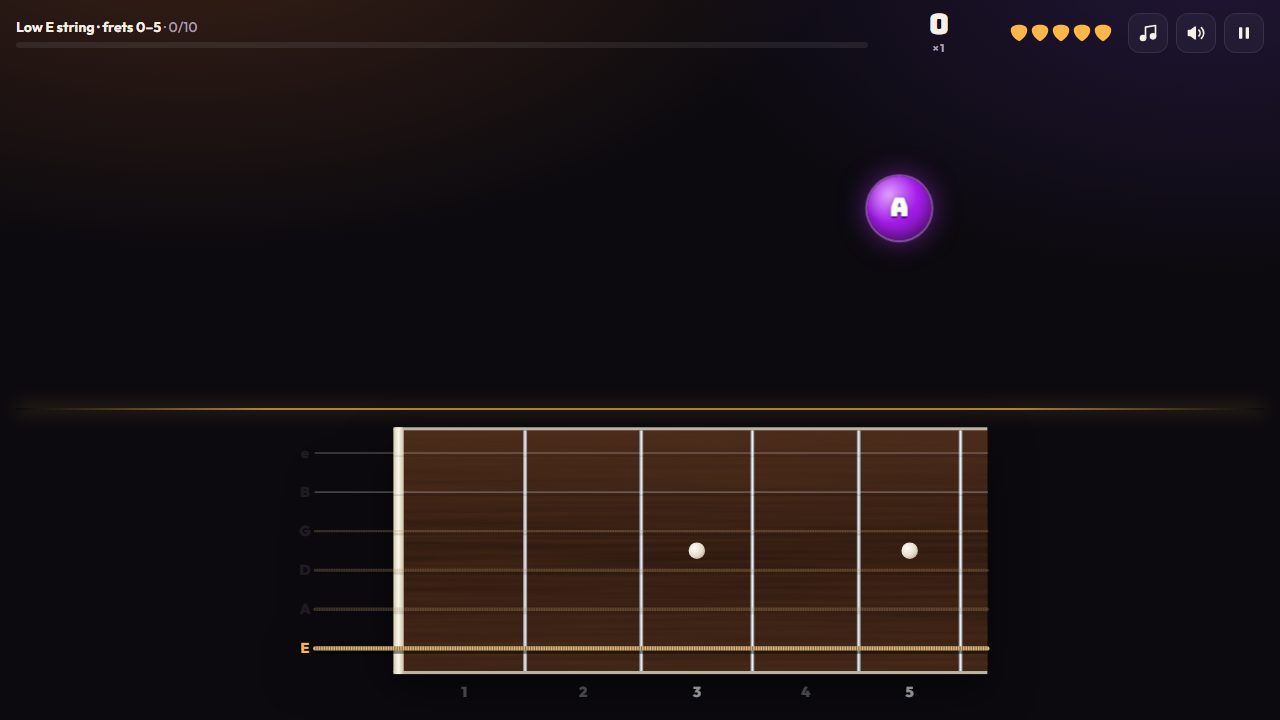
Start with Fretblast
Arpeggios are built from note names. Fretblast teaches you where every note lives on the neck, so when the mech wakes up you'll already know where A, C and E are. Free, in your browser.
Play FretblastQuestions
What is an arpeggio on guitar?
An arpeggio is a chord played one note at a time instead of all at once. A minor chord is A, C and E: its root, 3rd and 5th. Play those notes one after another, up or down the neck, and you are playing an A minor arpeggio.
Why should I learn arpeggios?
Arpeggios show you where a chord's notes are all over the neck. Solos that land on those notes when the chord changes sound musical instead of like a scale running up and down, so arpeggios are the bridge between playing chords and playing lead.
When does Arpeggio Assassin come out?
It doesn't have a date yet. Fret Arcade builds the games players ask for most, so pressing "I want this" on this page moves it up the list.
Do I need a guitar to play?
Fret Arcade's games can be played by tapping or clicking a fretboard, or with a real guitar through a microphone or an audio interface. Arpeggio Assassin is planned the same way.
What should I learn before arpeggios?
The note names on the fretboard. Every arpeggio is built from them, and knowing where A, C and E live makes the shapes easy to find. Fretblast, Fret Arcade's free fretboard game, teaches exactly that.